Greatest supercars that never made it to production

Greatest supercars that never made it to production

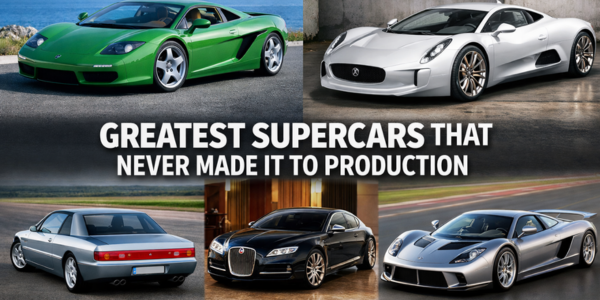
No other type of car spawns so many could-have, would-have and should-have conversations as the supercar.

Some don’t make it for lack of investment, while others are doomed due to a shortfall in styling or engineering.

We’ve gathered together those supercars that might have been but never were for a variety of reasons. They’re listed in chronological order:

Jaguar XJ13 (1966)

Developed in secret to challenge Ferrari at Le Mans, the XJ13 featured a 5.0-litre V12 and stunningly low, wide proportions. Unfortunately, shifting racing regulations and internal delays meant the project was obsolete before it ever turned a competitive wheel. Only one prototype was completed, making it one of the most mythical British supercars of all time.

Porsche 989 (1988)

Long before the Panamera became reality, Porsche experimented with a four-door, rear-engine V8 super saloon. The 989 promised Porsche performance with family practicality, but rising development costs and financial troubles in the early 1990s forced Stuttgart to abandon the project.

Ferrari Mythos (1989)

Designed by Pininfarina and based on Testarossa underpinnings, the Mythos was a roofless speedster concept built purely to showcase dramatic styling. While breathtaking to look at, its impractical layout and niche appeal meant Ferrari never seriously considered production.

BMW Nazca C2 (1992)

Penned by Italdesign’s Giorgetto Giugiaro, the Nazca C2 combined carbon-fiber construction with a BMW V12 engine. Despite strong interest and multiple prototypes, BMW decided the financial risk outweighed the potential reward.

Volkswagen W12 Coupe (1997–2001)

Volkswagen shocked the world by unveiling a mid-engined W12 supercar capable of over 200 mph. Several running prototypes were built, but the project ultimately became a development stepping stone for what would later become the Bugatti Veyron.

Cadillac Cien (2002)

Created to celebrate Cadillac’s 100th anniversary, the Cien featured sharp “Art and Science” styling and a monstrous V12 engine. Public reaction was positive, but production costs and limited market demand sealed its fate.

Chrysler ME Four-Twelve (2004)

With 850 horsepower and a carbon-fiber chassis, this American supercar was capable of humiliating Europe’s finest. Sadly, internal politics within DaimlerChrysler prevented it from ever reaching production.

Maserati Birdcage 75th (2005)

A rolling design experiment built to celebrate Maserati’s racing heritage, the Birdcage featured a canopy-style cockpit and radical aerodynamics. It was never intended for production, but its influence can still be seen in modern hypercar design.

Bugatti 16C Galibier (2009)

A four-door hyper-luxury sedan with the heart of a Veyron, the Galibier promised supercar performance with limousine comfort. Spiraling costs and changing brand strategy eventually led to cancellation.

Lamborghini Asterion (2014)

Lamborghini’s first serious hybrid concept combined a V10 engine with electric motors for over 900 horsepower. Despite positive feedback, the company chose to focus on pure combustion models at the time.


Lotus Esprit (2010)

The Lotus press conference at the 2010 Paris Motor Show has gone down in automotive folklore for its sheer ambition, with bold claims and five new concept models unveiled at once – including a reborn Esprit.

Not only was the scale of the product plan staggering, but the Esprit’s specification was equally eye-catching: a 612bhp 5.0-litre V8 engine paired with a seven-speed DSG gearbox, promising true supercar performance.

Following its debut, development was said to be progressing well. However, serious cracks were already forming behind the scenes. Lotus’ cash reserves were rapidly shrinking, and the CEO responsible for the ambitious strategy soon departed the company.

The result was the inevitable cancellation of the Esprit programme in 2014 – a particularly bitter disappointment given how promising the car appeared. On paper, it had all the ingredients to match, or even surpass, the McLaren MP4-12C, which followed a remarkably similar lightweight, driver-focused philosophy.

Bugatti 16C Galibier

All the cars produced by Bugatti in its present form (established in 1998) have been mid-engined, but that might not have been the case had the 16C Galibier reached production.

This ultra-luxury saloon shared its 8.0-litre W16 engine with the Veyron – an architecture previously previewed in the Bentley Hunaudières and Audi Rosemeyer concepts – although in the Galibier it was configured with two superchargers rather than four turbochargers.

More than almost any other car on this list, the 16C Galibier was a genuine near-miss. Bugatti originally intended it to become a production model before shelving the project, and in 2016 the company’s then-CEO, Wolfgang Dürheimer, publicly reconsidered the idea. Ultimately, however, the concept remained just that, and the world never got to see a four-door Bugatti on the road.

Bugatti 16C Galibier

All the cars produced by Bugatti in its present form (established in 1998) have been mid-engined, but that might not have been the case had the 16C Galibier reached production.

This ultra-luxury saloon shared its 8.0-litre W16 engine with the Veyron – an architecture previously previewed in the Bentley Hunaudières and Audi Rosemeyer concepts – although in the Galibier it was configured with two superchargers rather than four turbochargers.

More than almost any other car on this list, the 16C Galibier was a genuine near-miss. Bugatti originally intended it to become a production model before shelving the project, and in 2016 the company’s then-CEO, Wolfgang Dürheimer, publicly reconsidered the idea. Ultimately, however, the concept remained just that, and the world never got to see a four-door Bugatti on the road.

BMW M1 Homage (2008)

Thirty years after having its fingers burned by the original M1 supercar project, BMW unveiled the M1 Homage at the 2008 Concorso d’Eleganza Villa d’Este.

This haute couture gathering of classic cars and cutting-edge concepts was the perfect stage for a modern interpretation of the M1, even if BMW chose not to release so much as the most basic technical details.

As a result, the Homage was never intended to progress beyond a design exercise. However, its influence lived on: the concept directly shaped the 2009 Vision EfficientDynamics study, which would eventually evolve into the production hybrid BMW i8.

Lamborghini Miura Concept (2006)

The original Lamborghini Miura effectively invented the supercar when it was launched in 1966, so the company believed it could strike gold again with a reinvented, retro-inspired version four decades later.

Unveiled in 2006 to mark the model’s 40th anniversary, the Miura Concept was styled by Walter de Silva and featured a smoother, more contemporary take on the classic shape. Beneath those timeless good looks sat the same platform as the Murciélago, complete with a 6.2-litre V12 engine.

Unlike the original, however, the engine was mounted longitudinally rather than transversely. Lamborghini itself had no issue with this, and several customers were reportedly ready to place orders. But then-CEO Stephan Winkelmann put an end to the idea, insisting the brand should look forward, not backward.

Ford Shelby GR-1 (2005)

The Ford Shelby GR-1 concept paid homage to the Cobra-based Shelby Daytona Coupe racers of the mid-1960s, but it was very much a modern supercar. Under its sleek bodywork sat a 6.4-litre V10 engine, claimed to produce just over 600bhp.

At the time, Ford had no plans to put the GR-1 into production. However, in January 2019, Superformance of Jupiter, Florida – known for building continuation models of the Cobra, Ford GT40, and Chevrolet Corvette – announced its intention to bring the GR-1 to life. The updated version is set to feature a 750bhp Ford V8 engine, thanks to the Low Volume Vehicle Manufacturers Act enabling limited production.

Peugeot 907 (2004)

The Peugeot 907 was the French automaker’s answer to contemporary front-engined supercars such as the Ferrari 575M Maranello and the Mercedes SLR McLaren. Its 5.9-litre V12 engine, producing 500bhp, was ingeniously created by combining two of Peugeot’s existing 3.0-litre V6 units. Mounted longitudinally behind the front wheels to optimize weight distribution, the 907 was a serious engineering exercise.

However, as with the Volkswagen W12 Nardò, it’s questionable whether customers loyal to Ferrari or Mercedes would have been willing to pay similar sums for a Peugeot badge. Ultimately, the question never arose, as the 907 never advanced beyond concept form.

Selim Reza Avatar

One response to “Greatest supercars that never made it to production”

  1. […] How many onward flights a passenger can realistically catch after arriving at the airport within a practical time window. […]

Leave a Reply

Your email address will not be published. Required fields are marked *

Selim Reza

World History brings the past to life with clear, reliable, and engaging articles on global events, famous leaders, ancient civilizations, and major turning points in human history…