
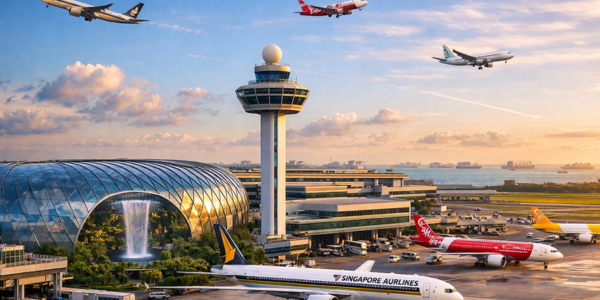
Singapore Changi Airport has long been celebrated as one of the world’s top aviation hubs — and the latest OAG Megahubs 2025 report reaffirms its status as a major global connector, even amidst fierce competition.
According to the influential aviation analytics firm OAG, Changi was ranked 11th among the world’s most connected airports in 2025 — a slight drop of two places compared with the previous year’s ranking. In the Southeast Asia region, it was placed second only to Malaysia’s Kuala Lumpur International Airport.
When an airport is called one of the “most connected” in the world, it doesn’t simply refer to how many flights take off or land each day. Instead, it measures how easily passengers can transfer between flights to reach different destinations.
The ranking by aviation analytics firm OAG focuses on connection potential, which includes:
1. Possible Flight Connections
How many onward flights a passenger can realistically catch after arriving at the airport within a practical time window.
2. Number of Destinations Served
Airports that fly to more cities and countries naturally create more routing options for travelers.
3. Flight Frequency and Scheduling
Well-timed arrivals and departures increase the chances of smooth, short layovers and efficient transfers.
4. Busiest-Day Analysis
OAG calculates rankings using data from the busiest day of the year, showing how airports perform under peak global travel demand.
Why This Matters
-
Shorter and more convenient layovers
-
More route choices if flights are delayed or canceled
-
Easier long-distance travel with fewer stops
-
Greater appeal for airlines, tourists, and business travelers
In short, a “most connected” airport acts as a global bridge, efficiently linking people, cities, and economies across continents.
For Singapore Changi, offering over 28,000 possible connections to 161 destinations shows just how powerful its network remains — even in an increasingly competitive aviation world.
Why Changi Still Matters
Despite slipping two places in the global rankings, Singapore Changi Airport remains one of the most important aviation hubs in the world — and for good reason.
First, its strategic location at the crossroads of Asia, Europe, and Australia makes it a natural transit gateway for millions of international travelers. This geographic advantage allows airlines to build efficient routes and offer smooth connections across continents.
Second, Changi’s dominance is reinforced by Singapore Airlines, which operates around 33% of all flights at the airport, strengthening its global network and ensuring consistent, high-quality connectivity.
Third, Changi is widely regarded as a benchmark for passenger experience. Travelers consistently praise it for its cleanliness, modern design, advanced facilities, and fast, well-organized immigration procedures. These factors reduce travel stress and make long layovers more comfortable and enjoyable.
Finally, strong connectivity supports more than tourism. It boosts trade, foreign investment, business travel, and the wider Singapore economy, positioning the country as a key global business and logistics hub.
In short, rankings may change from year to year, but Changi’s role as a world-class connector between nations, markets, and cultures remains as strong as ever.
What “Most Connected” Really Means
When an airport is described as one of the “most connected”, it does not simply refer to the number of flights it handles each day. Instead, it measures how efficiently passengers can transfer between flights to reach a wide range of destinations.
In the OAG Megahubs ranking, connectivity is calculated using several key factors:
-
Possible flight connections: How many onward flights travelers can realistically catch after arriving.
-
Destinations served: The total number of cities and countries accessible through the airport.
-
Flight frequency: How often flights operate, which increases flexibility and choice.
-
Schedule coordination: How well arrival and departure times are aligned to minimize waiting time.
-
Peak-day performance: Rankings are based on the busiest travel day of the year, showing how airports perform under maximum demand.
OAG Mega hubs: How Global Airport Connectivity Is Ranked
The OAG Megahubs report is widely recognized as the definitive ranking of the world’s most connected airports. Now celebrating its 10th anniversary, the report analyzes the 100 largest international airports, measuring connectivity based on total scheduled seats over the year.
The rankings are calculated using data from the busiest day in global aviation during the reporting period (September 2024 to August 2025), which fell on Friday, August 1, 2025. This approach ensures that airports are assessed at peak capacity, providing a realistic picture of their true global connectivity.
Connectivity is determined by two main factors:
-
Destinations served: How many cities and countries an airport links to directly.
-
Scheduled connections: The number of viable onward flights available to passengers after arriving.
In the 2025 ranking, Kuala Lumpur International Airport (KLIA) was placed in joint fourth position alongside Germany’s Frankfurt Airport, highlighting its strong role as a global aviation hub.
The OAG Megahubs report provides valuable insight into how airports connect people, businesses, and economies worldwide — a key metric for travelers, airlines, and policymakers alike.
Global Rankings: Where Changi Fits
Singapore Changi Airport continues to hold a prominent place among the world’s top aviation hubs, even as competition intensifies. In the OAG Megahubs 2025 report, Changi was ranked 11th globally, down two spots from 2024, reflecting the rising connectivity of other airports.
The top three most connected airports worldwide were:
-
London Heathrow (UK) – retaining the No. 1 spot for the third consecutive year.
-
Istanbul Airport (Turkey) – rising to second place due to rapid growth in connections.
-
Amsterdam Schiphol (Netherlands) – holding third among global hubs.
Meanwhile, Kuala Lumpur International Airport (KLIA) shared fourth place with Frankfurt Airport (Germany), making it the most connected airport in Southeast Asia and just ahead of Changi.
Changi’s position reflects both its extensive network and its reputation as a reliable, efficient transit hub. On its busiest day, it offered over 28,000 possible connections to 161 destinations worldwide, demonstrating that even outside the top 10, it remains a major global gateway.
These rankings highlight the increasingly competitive landscape of global air travel, where airports in Asia, Europe, and the Middle East are expanding rapidly to meet rising passenger demand.






Leave a Reply